← Back to all posts

Replace the middle, not the makers.

Anthropic's CEO is on tour again telling everyone that one hundred percent of code will be written by AI within twelve months. The implication is that programmers are the first wave of people whose jobs disappear. I run an AI implementation business and I write this from a decade in cybersecurity, so I get to say this with receipts. He is pointing the gun at the wrong people.

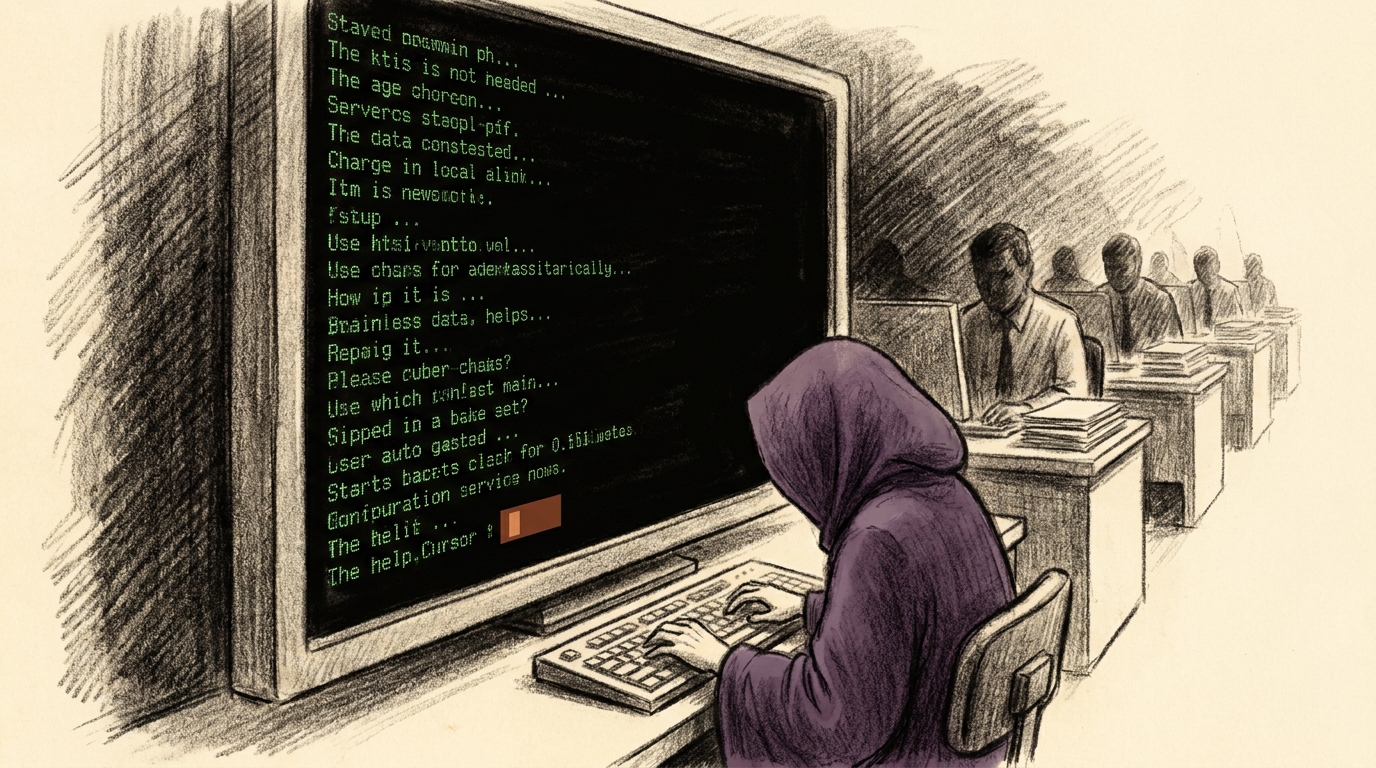
Charcoal sketch of a dark terminal window with green text scrolling, a small calm figure in deep purple typing at the keyboard, while in the background a row of office workers doing repetitive paper-shuffling work fades into shadow, burnt sienna accent on the blinking cursor

The story going around the AI conference circuit is the same every quarter. The labs announce something. A CEO says something dramatic about the timeline for replacing human roles. The press picks the most quotable line. The Twitter people argue about it. Six months later the timeline slips and a new dramatic claim takes its place. Right now the headline is one hundred percent of code, twelve months, programmers replaced.

I get why the labs say it. It sells stock. It sells enterprise contracts. The Anthropic and Blackstone and Goldman joint venture is a one and a half billion dollar bet that AI will do enterprise work, and the loudest narrative for that bet is "we will replace the people who write code." Big-business buyers love that line. Their CFOs love that line. The line is good for the share price of every public company whose engineering payroll is the biggest line on the income statement.

But for the small business audience I actually work with every day, that framing is wrong. And I think it is wrong in a way that does real damage.

Who actually does the work that should be replaced

I have spent the last decade as a penetration tester. I run external network security services for a security firm in Ontario. I know what is possible from a terminal because I have spent a non-trivial part of my life proving it. I have gotten into companies, read documents, exfiltrated data, moved laterally, escalated privilege, and left without anyone noticing. All of it from a command line. None of it required a human pressing keys, except me.

A terminal is a place where an entire business can be operated. The IRS pulls tax data, an accountant categorises it, a payroll system ingests it, a bank API moves money, a billing system stamps an invoice, a CRM updates a record. Every one of those steps is somebody copying data from one rectangle into another rectangle. The job titles vary. The actual work is the same. Move information from system A to system B. Translate one schema into another. Mash one button. Mash the next button.

That is the work that should be replaced. Not the work of a person who knows how to design a system. The work of a person who copies the output of one system into the input of the next.

Programmers are the wrong target

The reason CEOs keep pointing at programmers is because programmers are expensive and visible and easy to count. Each one shows up on a payroll line as a five or six figure number. Replace them with AI, the line goes down, the share price goes up. The narrative is "AI writes code now, you do not need the people who write code." It is clean. It is wrong.

What programmers actually do at a small business is not "write code." What they do is hold a model of how the systems fit together. They know that the email provider talks to the CRM through a flaky webhook that drops on weekends. They know that the QuickBooks import has an edge case for credit-card refunds that the bookkeeper has hit twice and miscategorised both times. They know that the new staff member did not read the runbook and is about to push a config that will break invoicing. The code is the artifact. The understanding is the asset.

You do not replace that with an AI that writes more code faster. You augment that with an AI that handles the work nobody actually wanted to be doing. The programmer transitions to architect. The intern, the operations assistant, the data-entry clerk, the manual-process-runner — that whole middle layer of the company — transitions to fewer headcount, with an AI doing the connecting work between systems.

Same charcoal sketch repeated at mid-post — terminal with scrolling code, calm figure typing, repetitive paper-shuffling workers fading into shadow behind

The honest version of the story

Anthropic's CEO is not crazy when he says AI will write more code. AI is writing more code. I use it every day. Every blog post on this site, every tool in my agent fleet, every script that wakes up at four in the morning to handle some piece of OAL operations — most of those started as me telling Claude what I wanted and Claude writing the code while I steered. That is real.

What is also real is that I am still here, doing the steering. The agent did not replace me. It replaced the version of me that would have been hand-typing each line of those scripts at midnight. The agent replaced the part of my work that was not the interesting part. The judgement, the architecture, the "is this even the right thing to build" — that stayed with me.

The honest version of the story is this. AI is not coming for the programmers. AI is coming for the work nobody wanted to do anyway. The job titles that go away are the ones that exist purely because somebody has to move data from one system to another. The job titles that grow are the ones that involve deciding what those systems should be doing in the first place.

What this means if you run a small business

If you are an owner-operator and you hear "one hundred percent of code by AI in twelve months" and your gut reaction is "great, I can fire my developer," you are reading the wrong signal. Your developer is the person who will be running the AI for you. The headcount you should be looking at to redeploy is the people whose entire job is moving data between tools you already pay for. The bookkeeper who reconciles QuickBooks every Tuesday because nothing connects to anything. The admin who pulls leads from your CRM and pastes them into a spreadsheet. The contractor you pay six hundred dollars a month to "manage your inbox" who is really just forwarding emails and adding tags.

Those are the roles where AI agents already do the work better than a part-time human, faster than a part-time human, at one tenth of the cost. Not because the human is bad. Because the work was always too repetitive to be the best use of a human in the first place.

The developer keeps their job. They become the architect of the agent that does the repetitive work. The repetitive worker either moves up the value chain or moves out. That is the honest reorg.

I am going to get flak for this. I am disagreeing with people whose names move markets. But I have been writing code in some form since I was a kid, sitting in front of a terminal trying to figure out how something worked. I have run engagements where the entire game was knowing which two systems to wire together that the company had never thought to wire together. The asset is not the code. The asset is the understanding of where the work actually lives.

AI does not change that. AI just lets a person with that understanding work at a scale that used to need a team of fifteen.

Replace the middle. Not the makers.

← Back to all posts