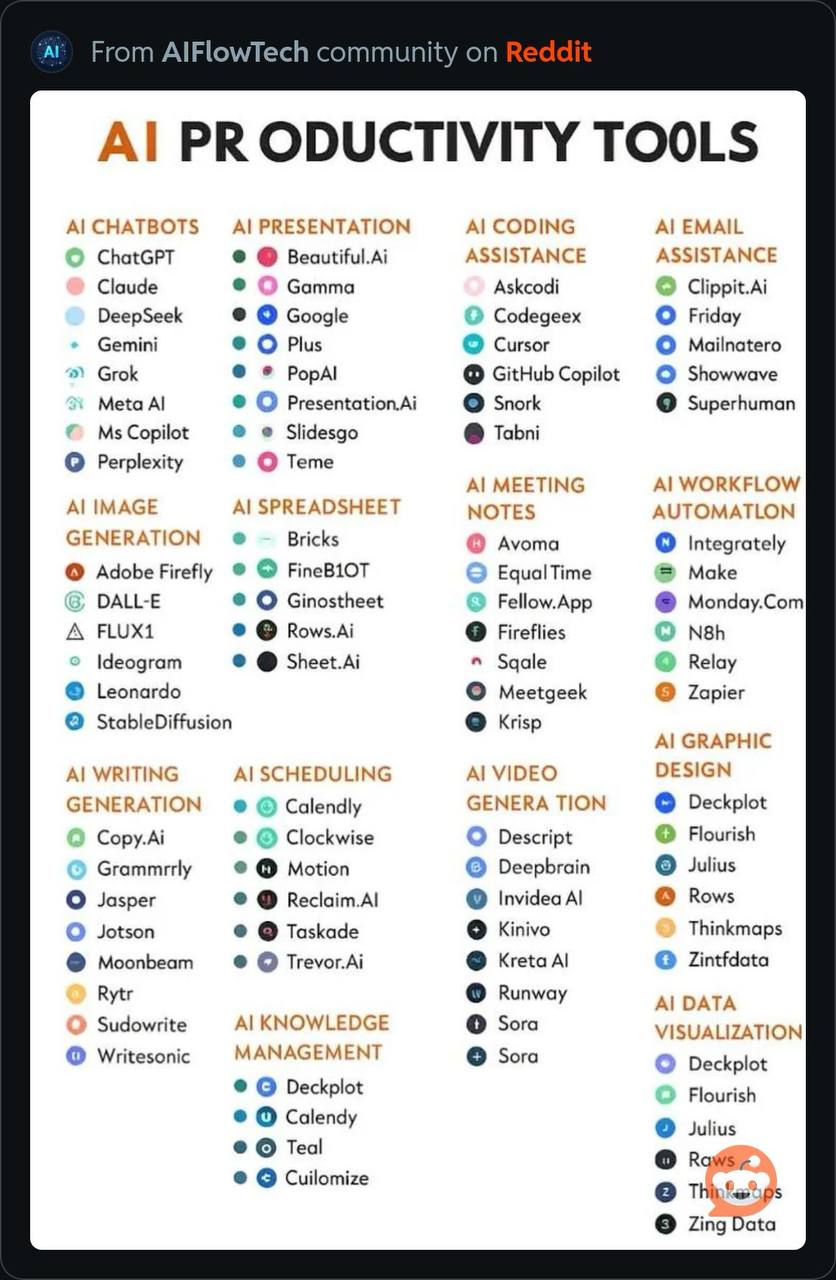
Look at that for a second. Eighty tools. Eleven groups. More if you count the copies in each row. Someone made it. Someone took a photo of it. Someone put it on Reddit. Now it sits in fifteen small business owner's saved links as "AI stuff I should use."
That is the wrong shape for the problem.
The grid is not a curated list. It is a vibe.
Half the names on that chart are typos. Grammrrly. Tabni. Snork. Codegeex. Jotson. Showwave. N8h. Sora shows up twice. Calendy is listed next to Calendly like they are two things. Deckplot shows up under three groups. This was not checked. It was made by AI or copied from somewhere and never fixed. The reason it gets ten thousand upvotes on Reddit is the visual noise. Not the facts.
That alone is the tell. If the chart were made by someone who used these tools, the names would be right. They are not. So it is not a guide. It is a feeling. The feeling is "look at how much there is, you should be doing more, here is all of it, where do I start, do I have FOMO yet, yes I have FOMO."
Then a small business owner looks at it. They think they need to be doing eighty things. They are doing one thing. The one thing is running their business. The eighty things are not the business.
What the grid is actually selling
Every one of those tools is a SaaS subscription. Every one costs between fifteen and eighty dollars a month. Most of them have a free tier that converts you in fourteen days. If you act on this grid the way it wants you to, here is what next year looks like.
Three writing tools you used twice. Two scheduling tools fighting each other for your calendar. A meeting transcription service for a meeting type you have once a month. An image generator you forgot to cancel. A workflow automator that handles one Zap. A graphic design tool that crashes on your laptop. Two presentation makers. Spreadsheet AI you tried once. Sometime in April you do the math. You are paying three thousand two hundred dollars a year for software you barely use. The work you wanted help with is still on your plate. The email triage. The follow-ups. The new-client onboarding. The invoice chasing.
This is the world the grid is selling. Not productivity. Subscription density.
What I actually run instead
I built Obsidian AI Labs because I lived through this shopping list. I got out the other side. I cut fourteen SaaS tools in one year. They got replaced with one AI stack on a server I control. The stack does the work of most of the groups in that grid. For real.
Writing tools. The blog you are reading was drafted by an agent reading my voice notes. It was polished by another agent that knows my style from years of my sent emails. Then it was read end to end by me. Nobody paid Copy.Ai or Jasper. The cost was a few cents of API calls.
Scheduling tools. I do not use Reclaim or Motion or any of the AI calendar things. My calendar gets dual-written to my work Google calendar and my personal iCloud in the same script. If someone asks me when I am free, the agent answers from the same source of truth I use.
Meeting notes. I do not use Fireflies or Otter. My agent gets a Telegram voice message from me. It runs it through Whisper. The transcript lands in my knowledge base. It is twenty cents.
Image generation. The hero images on every blog post on this site are generated through one API. I do not subscribe to Midjourney or Adobe Firefly. The cost is a quarter per image.
Workflow automation. I do not use Zapier or Make or n8n. The same agent that reads my email writes to my CRM and books the follow-ups. It is one stack. Not a chain of services with their own dashboards and their own pricing tiers.
Graphic design. I do not use Flourish or Thinkmaps. When I need a chart for a blog post, my agent renders it.
Meeting transcription. Knowledge management. Video generation. Presentation building. All of it is shaped the same way. One stack. A few hundred dollars a month in compute. No third-party data warehouses. No subscription rot.
The grid is the problem the customer brings me
Most of the talks I have with small business owners go like this. They show me their browser bookmark bar. They are paying for nine tools. Six of them are AI tools added in the last twelve months. Two of them they have not logged into for three months. None of them are talking to each other. The customer thinks the answer to their problem is another tool on the chart. The real answer is a small private AI stack that does the work of the other nine.
So when someone sends me an image like that and asks if I should add some of these to what we run at Obsidian AI Labs, the honest answer is no. Doing that would be the opposite of what we sell. We sell people getting out of that grid. Not us climbing further into it.
If a row catches your eye, that is a real signal
I want to be honest about the one caveat. Some of those tools are excellent. Some are the right answer for a specific job. If you look at that chart and a specific row jumps out at you because you have a real, named problem you cannot solve any other way, that is signal worth listening to. The trap is not any single tool on the grid. The trap is the shopping posture. Browsing eighty tools looking for one that will fix your business is what you do at three in the morning when you cannot sleep. Picking up one tool because you have a specific named problem you cannot otherwise solve is what an adult does.
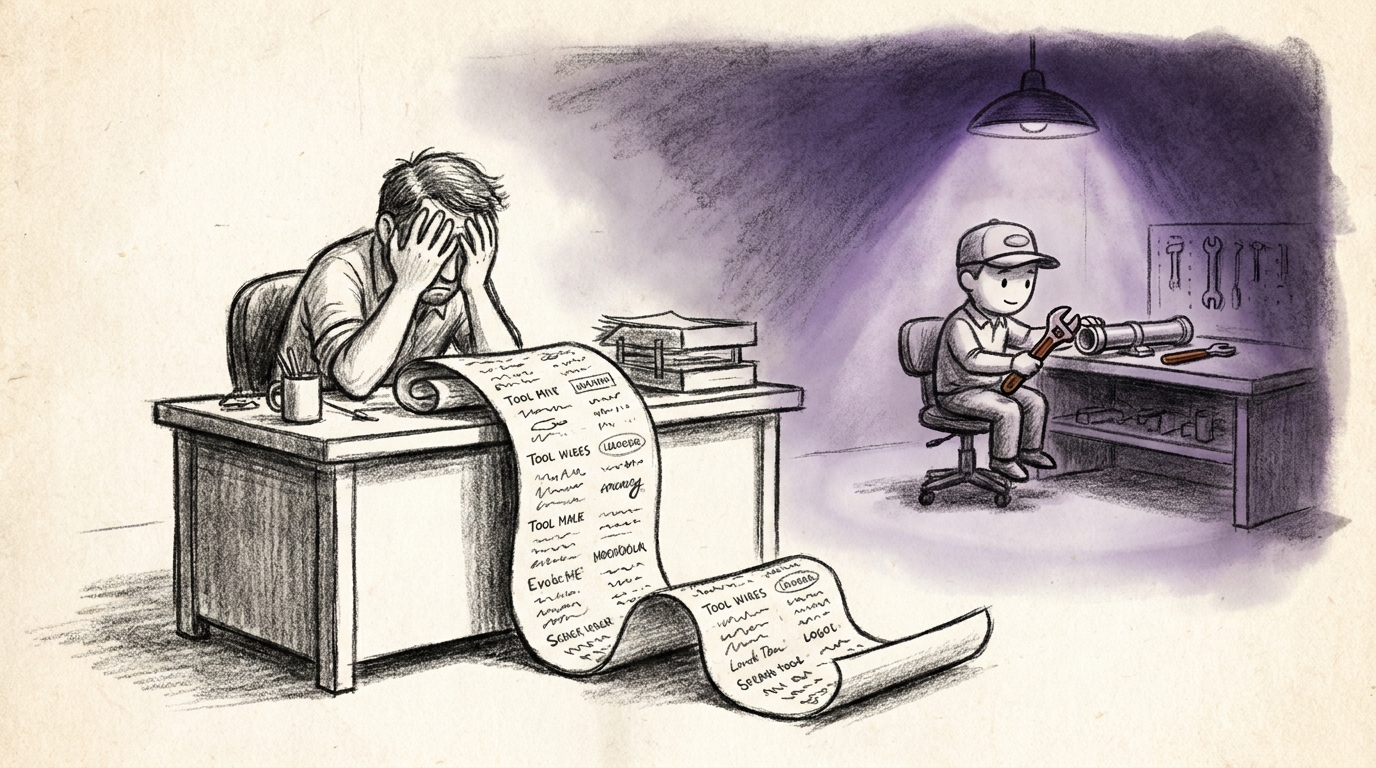
If you find yourself doing the first thing, the answer is probably not the chart. The answer is probably a quiet talk with someone who builds plumbing. Not someone who sells a row.