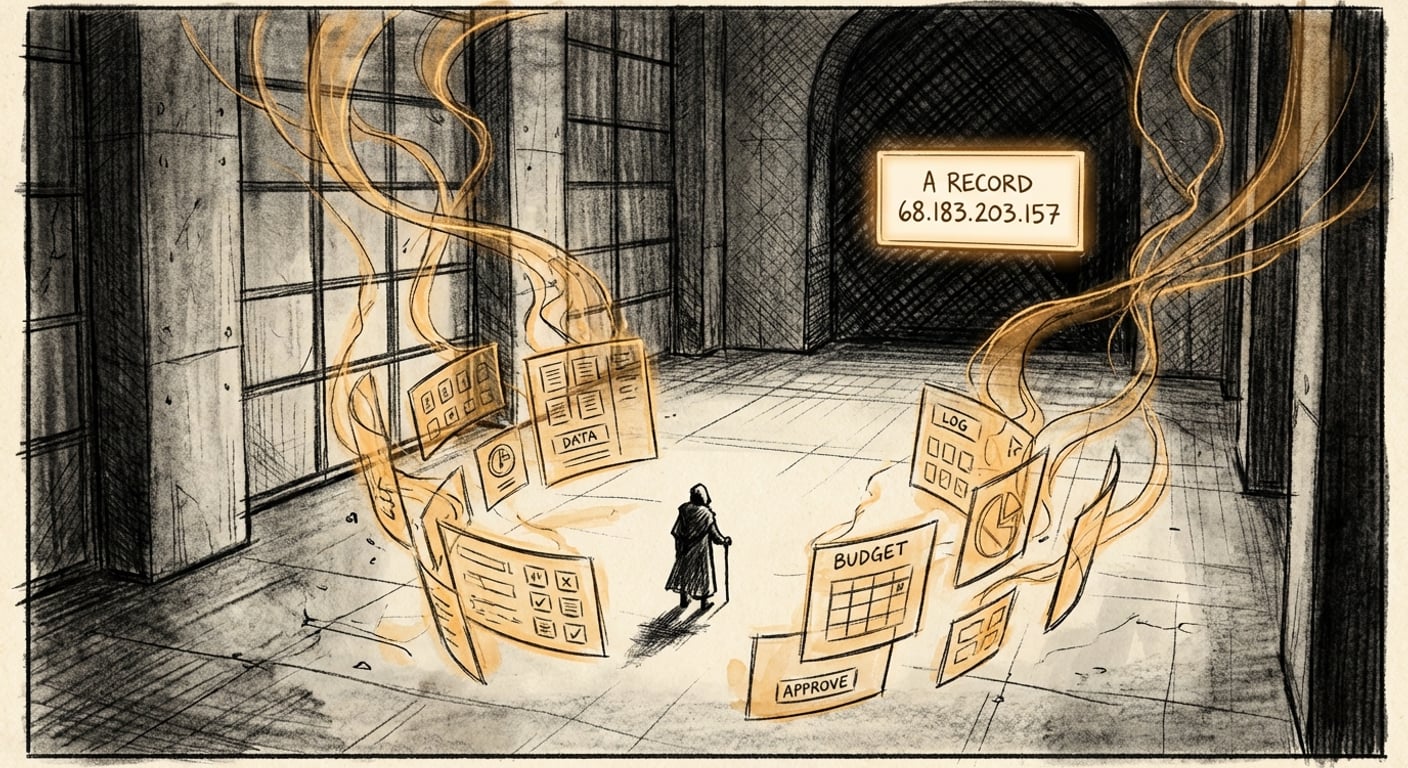
AI is going to take over everything. And your DNS records are already gone.
Okay. Small thing from this week. Then what I think it means. If you stay with me, by the end you will be excited or nervous. Both are fine. Here is the moment. I asked an AI agent to change a DNS record on GoDaddy. It did it. Took about 40 seconds, start to end. The record is still sitting there. Still doing its job. Right now. That is where this blog post lives.
The small thing, in full
Here is what happened in concrete terms. I was in the middle of a build session. The new version of this website needed a live URL. The domain is on GoDaddy (a whole separate rant for another day. GoDaddy is fine. I am not mad at them. They are not my favorite). I had a fresh droplet on DigitalOcean with the site running on it. I needed the root A record on obsidianailabs.ca to point at the droplet's IP so the internet would know where to go.
The old way this goes: log into GoDaddy, find the DNS panel, remember where they hid it this month, click through to the records list, find the A record, click edit, paste the IP, change the TTL, click save, wait for it to spread, curl the domain, refresh, swear, refresh again. Maybe ten minutes of small, careful clicks. Fifteen on a bad day. And the whole time the thing your brain is working on. The thing you wanted to ship. Is getting colder because you are clicking through someone else's admin panel.
The new way: I said change the A record for obsidianailabs.ca to point at the new droplet, TTL 600. Done. The agent grabbed the droplet's IP from the DigitalOcean API. It hit the GoDaddy API. The record flipped. The site was up. I kept working. I never touched a GoDaddy page. The tab was not even open.
How hard was that actually?
Not that hard. That is the part I need you to sit with for a second. GoDaddy has a documented REST API. Anyone with an API key can read, create, update, and delete DNS records via HTTP. My agent needed about 30 lines of wrapper code so it could translate a natural-language request (change the A record for X to Y) into the right PUT call. Thirty lines. One afternoon of work. Probably twenty minutes of that was me reading the GoDaddy docs because they are organized in that specific way docs get organized by committees.
And the kicker. Once the wrapper existed, it was done. It does not decay. It does not forget. It sits there, ready, waiting for the next time I (or any other agent in the system) want to touch DNS. Next time I spin up a droplet and need to point a subdomain at it, it is another 40 seconds. Not another ten minutes. The cost of the second DNS change, and the third, and the thousandth, is zero.
That is the thing I want you to feel in your body. Not "AI is getting smarter, spooky." That framing is a distraction. The thing is way more boring and way more profound: every business system with an API is about to become one natural-language sentence wide. Not at some point later. Now. With tools that exist. The agent does not need to be superhuman. It needs a wrapper and a reason.
The list gets long fast
Let me make this real. Here is what sits on the other side of that line in my own setup. See them all at once and you can not un-see it. Each one used to be a system I clicked through by hand. Now it answers to one sentence:
- GoDaddy . Domain search, availability, WHOIS, DNS records, the whole account
- DigitalOcean . Spin up droplets, resize them, snapshot them, tear them down
- Google Workspace . Gmail (read, label, search, draft, send), Drive (upload, share, delete), Docs, Sheets, Slides, Calendar, Contacts
- Obsidian . Read, write, search, and navigate my entire knowledge vault via the local REST API plugin
- Telegram . Send messages, read replies, react, edit, attach files, all scripted
- Apify . Run any scraping actor on any social platform from a single sentence
- Replicate + Gemini + OpenAI + ElevenLabs . Image generation, voice synthesis, embeddings, model calls
- Cloudflare . Workers, pages, DNS, analytics, caching
- Notion . Pages, databases, comments, search
- Apollo, Brightdata, Perplexity . Data sourcing at whatever depth the task needs
And the list grows every week. The marginal cost of adding a new system to that list is low once you have done it a few times. You write a wrapper. You name the actions in plain English. You let the agent figure out which action matches the sentence. That is it. No frontend. No UX design. No "how will users discover this feature". No onboarding flow. The agent IS the UX.
If you step back and squint, what you are looking at is the end of most clicking. And I mean most. Not "click less" like the SaaS vendors have been promising for ten years. I mean: the entire interaction pattern where a person opens a tab, finds a thing, clicks into it, fills out a form, and clicks save. That whole shape of work. Is about to move to the background. It is going to keep existing for auditing and edge cases, the way physical mail still exists. But the default way a task gets done is about to become "describe what you want, and then the tools do it."
So what happens to all that saved time
Here is where most AI takes get scary or utopian. I want to stay in the boring middle. The boring middle is where the truth lives.
A lot of people talk about this as "AI is taking jobs." Some of that is real. But the more interesting thing. And the thing I keep catching in my own work. Is that it is not taking jobs so much as it is taking the friction layer of jobs. The part of your job where you click through panels, copy and paste between tabs, remember which login goes with which tool, update spreadsheets, format documents, rename files, rearrange DNS records, send 30 emails that are all the same email. That layer. The part nobody wanted to do, that they were doing because it had to be done.
When the friction layer disappears, the thing you are left with. And this is the part nobody warns you about. Is the ideas layer. The "what should I be doing" part. The "which problem is worth solving" part. The "is this a real opportunity or am I kidding myself" part. That layer never got automated. Nobody is wrapping a GoDaddy-API equivalent around it because there is not one. It is you, in a room, thinking about what to do next.
Here is the embarrassing part I keep noticing about myself. That layer is hard. Way harder than I gave it credit for. My whole working life, the clicking layer was so thick I could hide inside it. I could stay busy. I could feel productive. I could look at my calendar at the end of the day and see a row of checked boxes. None of them answered the real question. The real question is, what do I want to build next. That one is scary. It has no deadline on it.

The idea economy is already here
I have been calling this the idea economy in my head for a couple of months, and I am going to keep calling it that. The old economy. Knowledge work, 2000s through 2020s. Ran on "can you do the thing?" Whoever was fastest and most accurate at executing tasks in a domain got paid the most. The whole career ladder rewarded operational excellence. You started out clicking, you got good at clicking, you got promoted to telling other people how to click, at some point you ran a department full of clickers, and your value was "I can get this department to click better than the one across the hall."
That ladder is not gone. Most ladders are not gone yet. But the rungs at the bottom are going soft. Anything that is "do this careful operational thing over and over" is becoming a one-sentence request. And the rungs at the top. The ones that were always about judgment, framing, taste, and picking the right next problem. Those are becoming the only rungs. Because the thing they rewarded (knowing what to point everyone at) is the thing that did not get automated.
So the people who are going to do well in the next few years are not the ones who "use AI". Everybody is going to use AI. That is the baseline, not the thing that sets you apart. The ones who do well are the ones who can stand in the middle of a room where anything is now possible and pick something. And pick something good. Something that matters. Something that was not obvious. Something the sentence-completion machines would never have suggested on their own, because it was not in their training data, because it did not exist yet.
It is a creative muscle. Not a new one. Small kids have it at a level that is embarrassing. School beats it out of them. Some founders keep it. Some artists. Some scientists. They keep it by refusing to fully grow up. It is the skill of looking at a normal thing and saying, wait, what if we did this whole other thing here. Without being scared of sounding dumb. The skill of having an idea that was not on the list.
Why "out of the box" stops being a cliché
Take the phrase out-of-the-box thinking. It used to be a cliché. It was a show. You saw it in job ads and on posters. But no one wanted you to think out of the box. They wanted you to do the work inside it. They wanted you to look like you were thinking outside it. The box was where the real work lived. Inside the box was fine. Inside the box paid the mortgage.
The box is the clicking layer. The box got scooped out. Work does not live in the box now. Agents do. So the line, out of the box, stops being a cliché. It stops being a show. It turns into a job rule. Not, can you have a weird idea at a brainstorm. Here is the real ask. Look at what got possible. See what no one else sees. Say it clear so the system can go do it.
That is writing, strategy, synthesis, pattern-matching, taste, judgment, and courage. All mashed together into one skill that used to be called "being creative" and is about to get called something more serious. The people who have that muscle developed are about to look like they have a superpower. Not because they got smarter. Because the friction that used to hide the gap between "has ideas" and "does not have ideas" is gone. You can not blame the calendar anymore. You can not blame the admin work. You can not say "I would be more creative if I had more time." You are going to have the time. The test is whether you have anything to do with it.
The uncomfortable landing
I am not trying to scare you. But I will not act like this part is fun. Maybe you built a career on doing the work well. Maybe you never built the part of you that picks what work to do. If that is you, the next two or three years will feel off. You will not have a word for it. Your clicking skills will start to feel less useful. Your judgment will start to feel more useful. And you may not know how strong your judgment is. You have not had to lean on it in a while.
The good news. And I do mean good news. Is that the judgment muscle is trainable. You do not need a PhD. You do not need to be a visionary. You need to start practicing the thing that got squeezed out of your day-to-day. Pick a small problem. Decide what to do about it. Describe it clearly. Watch a system go do it. Evaluate whether the result was what you wanted, and if not, why not. Do that again. Do it a hundred times. That is the training. It does not feel like training because it does not feel busy, but that is the point. Busy is over. Busy was the clicking layer. The new thing is not busy. The new thing is sharp.
The GoDaddy DNS thing did only take 40 seconds. I did save nine and a half minutes. And then I stood there, in my office, asking myself the question I have been asking myself a lot lately, which is: now what. And the honest answer is that the question is the work now. It always was. I could not hear it over the clicking.
I will let you know what I figure out. Meanwhile. You can go do this too. There is nothing special about my setup. The APIs are public. The wrappers are cheap. The sentence is the only part nobody can write for you.
← Back to all posts