The Charge From Bangalore
Two charges from a firm I had never heard of, halfway around the world. I asked the agent. Thirty seconds later I had the answer.
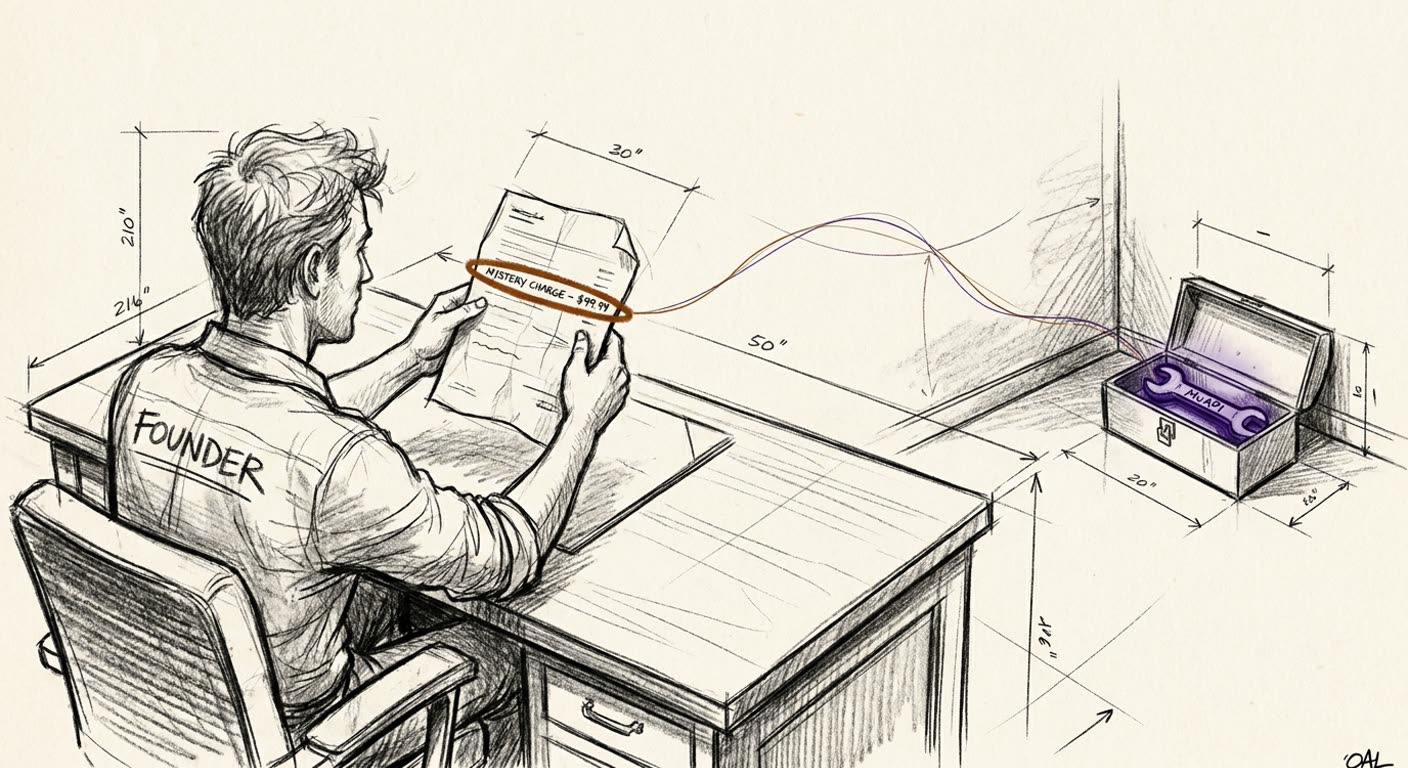
Two charges showed up on my credit card. From a firm called Vadoo Internet Services Private Limited. Bangalore, India. Ten US dollars each. Two days apart at the end of April.
I had no idea what they were.
That feeling is one any small business owner knows in 2026. You scan your card statement. You see a name you do not know. Your first thought is fraud. Your second thought is "did I sign up for something and forget." Your third thought, if you are me, is "ask the agent."
So I asked.
What the agent found in about thirty seconds
Vadoo Internet Services Private Limited is the legal name behind a service called MuAPI. MuAPI is an image-to-video gateway. You give it a still image. It gives you back a few seconds of motion. There are about a dozen models behind it now. Seedance. Kling. Veo. Others. Pay per clip. Somewhere between five cents and thirty cents based on which model you pick.
I had wired MuAPI into my Personal AI Setup on April 30 to play with content for YouTube. Image in. A few seconds of motion out. About a dozen ways the result can land in a video edit. I had forgotten about it. The way you forget any tool that just works.
The two ten-dollar charges were trial credit topups. The first one funded a few minutes of video. The second one funded the rest of the same tools day on April 30. I was wiring up six new pieces of setup at once and burning through credits without really thinking.
Total cost of the unknown thing: twenty US dollars. Total time to ID it: about thirty seconds. Most of that was waiting for the API call to my gmail to finish.
Why this is worth writing about
It is not because the charges turned out to be fine. It is because the whole detect-to-explain loop happened without me leaving the Telegram chat.
The path I would have taken with no agent:
- See the unfamiliar charge
- Open my email and search for "vadoo"
- Find the receipts
- Click through to the linked support site
- Realize it's the parent company of muapi.ai
- Try to remember when I signed up for that
- Find where I stored that service's key, search for muapi
- Realize this is the tool I'd built into the blog pipeline
- Categorize the charge in my head as legitimate
That is maybe a fifteen-minute task done right. Probably forty-five minutes done with distractions. Very likely either skipped or filed under "I will figure it out next month."
The path I took with an agent:
- Send a voice memo saying "what's this charge"
- Read back two paragraphs
The thirty seconds in between is the part that matters. The agent looked through my own notes for any sign of vadoo. Found none. Looked up the API key in the list of services I use. Found a match. Looked through my gmail for receipts. Found two from Vadoo. Both Stripe-issued. Both for ten dollars. Both within a 14-hour window. Read the receipt bodies. Pulled the dollar amounts. Tied Vadoo back to muapi.ai based on the email text. Pulled the dates of the receipts. Cross-checked those dates against my own work logs. Saw a cluster of ten projects dated April 30. All touched blog or video pipeline work. Wrote me the answer.
Each one of those steps is a thing I could have done by hand. I have done them by hand many times. The shift now is that they do not take fifteen minutes. They take thirty seconds. And I do not have to remember any of them. I just have to ask.
The deeper thing this points to
Most of the friction in running a small business is not the hard parts. It is the medium parts. The things that take fifteen to forty-five minutes that you keep putting off. They do not feel urgent. You have something more key to do. The strange charge. The contract you should re-read. The vendor you should call. The receipt you should file. The email you should follow up on. The call you should make about whether to keep the SaaS plan that auto-renews next week.
These things are not hard. They are friction.
Friction stacks. A hundred fifteen-minute frictions a month is twenty-five hours. A hundred forty-five-minute frictions is seventy-five hours. That is two weeks of full-time work that nobody is doing. So it piles up in the corners of your business. Until something breaks because you did not read the email. Or you did not sort the charge. Or you did not call the vendor.
What an agent does, when it is wired up right, is eat the friction. It does not swap out the hard parts. The hard parts are still you. But the medium parts go away.
If the agent had told me the charge was off, the next step was to lock the card. The agent did not tell me that. The agent told me it was a tool I had set up two weeks ago and forgotten. That answer is also worth something. I do not have to lock the card. I do not have to call the bank. I do not have to file a fraud report. I can keep doing what I was doing.
The whole swap took less than a minute. Most of that was the agent typing out the read in plain words so I would get it.
This is the part of running a small business that gets less press than it should. It is not the big part. Nobody writes a case study about "I figured out a charge in 30 seconds." But over a year, the medium-friction tasks I no longer have to do add up to more time than the big ones did. I get to spend that time on the work that moves the needle.
The charge was from Bangalore. The tool was mine. The answer was in my own files. I just needed something patient enough to look.
That is not future tech. That is what I have running on a laptop right now.
← Back to blog