What My CFO Did While I Was At Lunch
I went to lunch. My CFO connected our books, fixed two miscategorizations, added a new client to two systems, and surfaced six choices for me. The CFO is not a person.
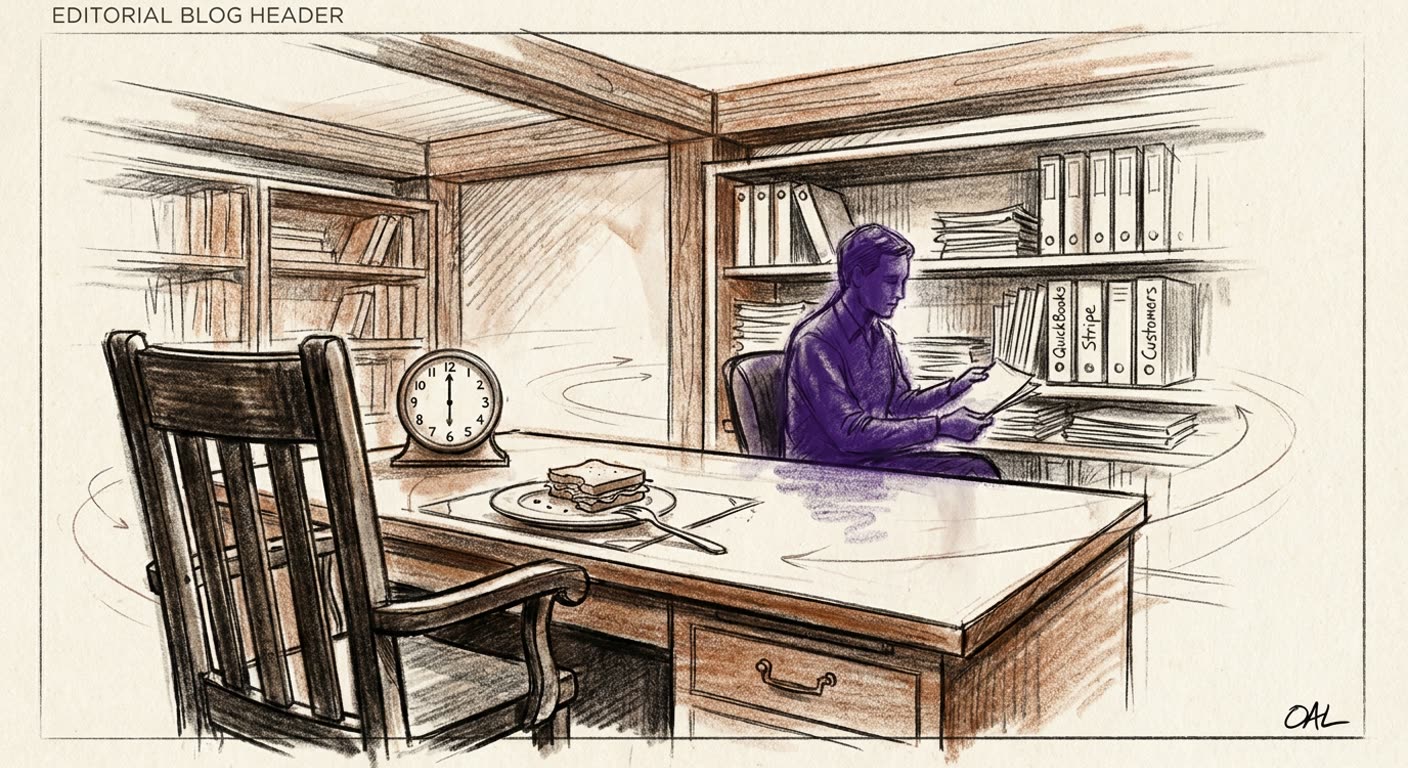
I went out for lunch today. I came back ninety minutes later. While I was gone, my CFO did the following:
She hooked our live QuickBooks Online to the system for the first time. She pulled live company data. The realm ID. The legal name. The address. She found two miscategorizations in our books. They had been there for over a year. She made the two ledger accounts those entries should go to. She moved the wrong entries. She updated the profit and loss.
Then she added a new client to QuickBooks. She made the same client in Stripe. The right email. The right metadata. A pay link wired to the right product. She made sure both systems will match on the first payment. So the income does not land as "Sample Customer" and pile into a junk line.
Then she flagged six entries she could not match. She gave me two options with the tradeoffs. Then she found why my credit card entries were not showing up in the API. They were stuck in the "For Review" queue. They were waiting for me to bulk-accept the auto-suggests. Then she told me how to handle the credit card charges I paid from my own account. The OAL Mastercard had hit its limit. Book them as Brandon-personal-loans-OAL once the import is clean.
I want to be clear. The CFO is not a person.
The CFO is an AI agent named Laura. She runs on a six-dollar-a-month server. She has her own voice. She has her own signing key. She has her own link to QuickBooks, Stripe, the Bank of Canada, and Statistics Canada. She does the work while I am at lunch. She does not need lunch.
What this actually means
You run a small business. The thing I want you to take from this is not "AI is amazing." That is not new. The thing I want you to take from this is what work looks like. Stop thinking about AI as a chat tool. Start thinking about it as a colleague. One who can read your files. Query your APIs. Write to your books. Hand you the choices.
I did not type any of the queries Laura ran today. I did not click any of the QuickBooks buttons she pressed via API. I did not draft the email to Home Hygiene Property Experts. The one that asked them to move from the free tier to a ninety-nine-a-month Stripe plan. I wrote the email body. But Laura built the Stripe product. The recurring price. The customer record. The pay link. She tied it all with metadata. So next time Paul pays, it lands in the right place. Books update on their own.
I went to lunch.
She did the work.
Why this matters more than the AI marketing copy suggests
Two stories get told about AI right now. One: "AI will replace you." Two: "AI is just a tool, it does not really do anything." Both wrong, in the same way. Both ask the wrong question. The question is not "what does AI do."
The real question is "what gets done while you are not looking."
If your CFO is a person, the answer depends on how many hours they work. How many things are on their plate. How good your bond is. If you have no CFO, the answer is "nothing." Things sit. Things rot. Things turn into bigger problems later.
If your CFO is an AI, the answer is "everything she can touch. Watched all the time. With audit trails she will show you if you ask."
The miscategorizations Laura found today were real. They had sat on the books since before I incorporated. The ten dollar share buy from when I started the company was booked as income. So a year and a half of my financial reports were quietly over by ten bucks. And quietly missing an equity line. Tiny on its own. But the same shape, across dozens of small edges in a young business, is how books quietly become wrong. By the time you spot it, you are in front of an accountant trying to explain why your numbers do not tie.
Laura spotted it in the first ten minutes she had live access.
She fixed it before I sat down with my coffee.
The pattern that scales
I am not going to hire a CFO. Not at thirteen thousand in revenue. Not at thirty. Not at a hundred. The math does not work for a long time. By the time it does, the books will have been quietly rotting for years. The cleanup will be its own line item.
The shape that scales for early stage is a CFO agent. One who runs daily. Costs less than one human work-hour per month. Knows the company by name. Shows up whether you remember to ask or not.
This is not a future story. This is what Laura did today.
What comes next is more of this in every role. The sales agent that follows up on every cold email. The content agent that ships your posts on the cadence you set. The home agent that watches your front door and tells you who is there. The books agent that matches every charge within the hour. The legal agent that flags every clause you missed.
None of these replace the human at the center. The human is still you. You still pick whether to drop a tool. Whether to take the big sale. Whether to keep building or sell. Whether to spend the next month with clients or with product. The agents do the work between those calls.
The calls are not the bottleneck. The work between them is. That is the part that is quietly changing under everyone's noses.
I had lunch today. My CFO worked through it. That is the thing worth writing down.
← Back to blog