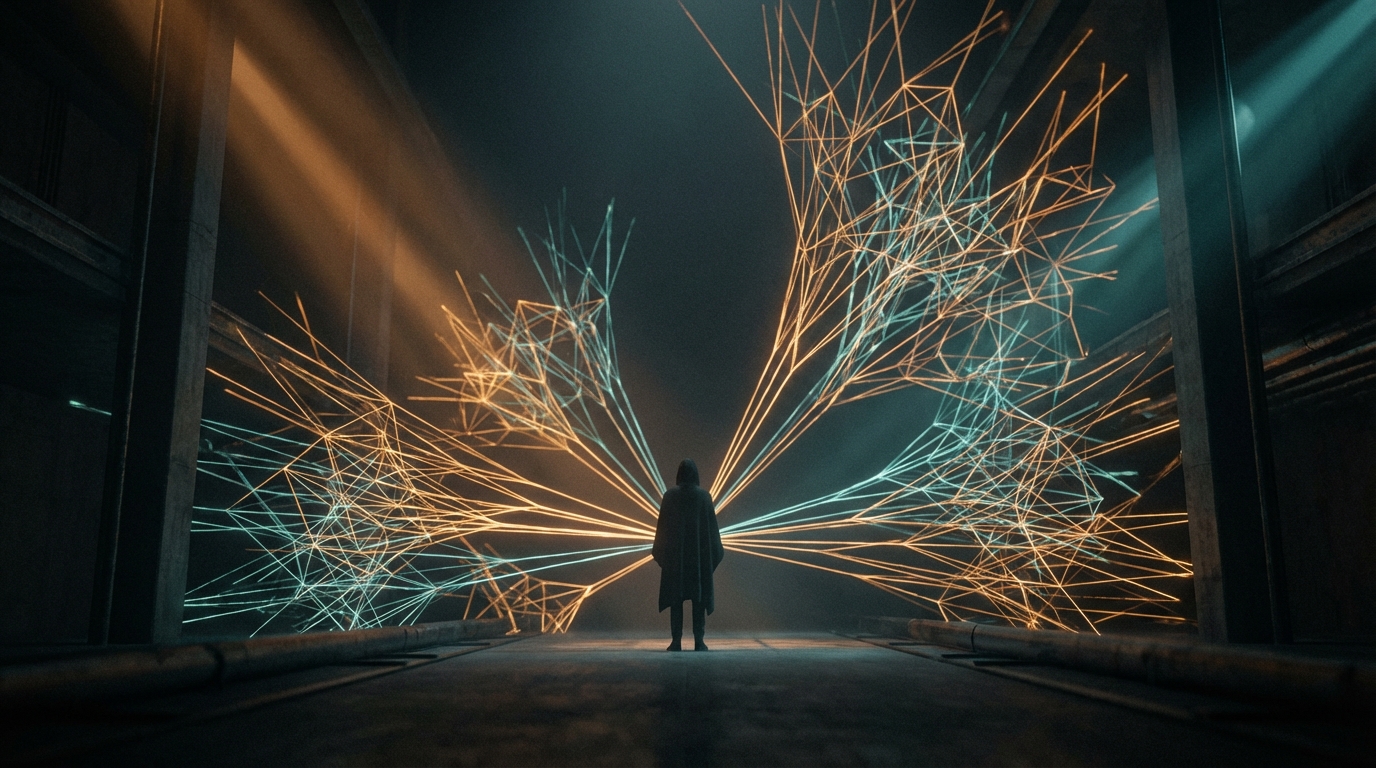
What exponential actually feels like.
Honestly? For most of my life I just pushed harder. Every day. Over and over. Trying to do more, be more, be enough. There's never enough time in the day. That was the rule, and I operated inside it for years. And then something shifted in the last month or two, and I've been trying to figure out how to describe it, because it's not what I thought it would feel like.
The old math
The old math was simple and tiring. If I wanted more output, I needed more hours. More meetings, more spreadsheets, more tabs, more cycles burned. Productivity advice boils down to "get better at the grind," and once you're good, grind harder. So that's what I did. Wake up earlier. Stay later. Skip lunch. Double-book the calendar. Run two things at once. I got pretty good at it, honestly. Not braggy-good, just functionally-good. I could stack a day tight when I had to.
The problem with that math is it has a roof. You can only push so hard before your body quits. Before your brain quits. Before the people near you quit on you. Once you hit that roof, the only lever left is "push harder" which is a bad lever. It does not move anything. I hit that roof a bunch of times. Most people do. And if the roof is all you have, then the roof is where your output stays forever.
What changed
I'm not going to get into the specifics of what I've been building because this post isn't that. But the short version: I started bolting AI agents onto the workflow instead of doing every step myself. And something happened that I didn't expect. It's not that I'm suddenly doing way more stuff. It's that I keep hitting this weird mental wall I never used to hit: what's next?
I used to have a problem I didn't know I had, which was that I loved building things. Not in a struggling-against-it way. In an opposite way. I liked coming up with an idea, and then I liked building the thing, and then I'd look up and go "okay now what?" as if I forgot the end goal somewhere between steps one and two. The building was the reward. The point was the process.
With the AI layer sitting underneath, I get to "okay now what?" so much faster. Hours faster. Sometimes minutes faster. I'll have an idea at breakfast and by lunch the thing I wanted to exist exists. And I'm standing there in my office at 11:30 AM going ..huh. Okay. Now what.
Maybe it's a good thing. Maybe it's a bad thing. I still don't know yet. But I think this is what it means to actually change a workflow. Not just "do the same thing faster". An actual phase change, where the constraint that used to rule your day stops ruling your day, and whatever was hiding behind that constraint comes into view. And what was hiding behind my constraint was a question I haven't had to answer in maybe ten years: what do I actually want to do with this time?

The word for it
Somewhere in the middle of all this I was trying to figure out what to call the thing I'd built. Assistant. Agent. System. Nothing quite fit. Then one night I was explaining it out loud to myself, debugging a workflow, and the word that came out was helper. Just helper. Not replacement, not threat, not magic box. A helper. Something that's there when you need it, quiet when you don't, no ego about the work.
And I sat with that for a minute. Because "helper" is the word a kid would pick. A kid who hadn't read the hype cycle. A kid who didn't know the fear cycle. No podcast had told them what to feel about any of it. Take away the marketing. Take away the doom. What's left on the screen is just a helper. That might be the truest word anyone has used for it. Most grown ups in this space would never say it out loud. It sounds too simple.
That simple thing hit me hard. I did not see it coming.
Because this is the thing. What exponential actually buys you isn't more work output. I mean it does that too, sure, but that's not the headline. The headline is that the time you used to spend crushing the grind opens up. And it opens up into real life. Into the thing that was there the whole time you were too busy to look at it.
Where the reclaimed time has to go
I've been doing this all day at a desk. In my office. Alone. I'm an ethical hacker by trade. I've made my entire living off of being good at computers. And sitting there with the word helper rolling around in my head, watching a thing on a screen quietly do work that used to eat my evenings, I realized something kind of embarrassing to admit: I've been spending all my time in a digital environment, and the exit door from that environment is the entire point of building what I'm building.
Some things matter more than spreadsheets. I know that sounds corny when I type it, but I'm typing it because it's what I'm thinking. For some people, the time they get back goes to family. For others, it goes to art. Woodworking, welding, painting, writing. For others it's being outside, being with friends, being in a room with other humans who don't load over the web. None of that scales with AI. None of it gets 10x better because you bolted an agent onto it. It stays analog on purpose, and that's the whole point.
At the end of the day, we need to be with people more. My whole life is digital. I'm realizing tonight that I wish I'd spent more of it in a room with other humans. Not because digital is bad. The helper on the screen is doing exactly what a helper should, and that's fine. But because the point of removing the grind is that you go do the other thing, and the other thing is always going to be over here, not in the laptop.
So what does this actually mean
I don't think you can think your way into exponential. You can only experience it, and then the experience reshapes how you think about what was possible in the first place. Two months ago I'd have told you that the ceiling on what I could build was "me with more hours". Two months later the ceiling is "me with more ideas", and I have fewer ideas than I'd like to admit because I spent years training myself to have just enough ideas to fill the hours I had.
So I'm retraining now. I want to get okay with the empty space. The "okay now what" moment. I want the answer to be "go sit on the porch for ten minutes" more often. Or "call someone back". Not just "stack another task on the pile". I'm bad at it. My default is still the desk. But I'm getting better.
Honest ending. I don't know where this goes. People change sometimes. I feel like I'm in the middle of one of those changes. I don't have a clean wrap-up. I can't tell you what it all meant. What I have is a quiet office. A helper doing its job on the screen. And a new problem. What do I do with an hour that didn't exist two months ago. Tonight I closed the laptop. That felt like the bigger call.
If any of this sounds like you. You push hard. You keep pushing. You catch yourself asking where the time went. Maybe the point of all this AI stuff isn't that you do even more. Maybe the point is you finally get to stop pushing. And the real question, the one waiting under all that noise, was always the one that mattered most.
I'll let you know what I figure out.
← Back to all posts